Vector Dot Products
By M Ransom
Introduction: In this lesson we will examine a combination of vectors known as the dot product. Vector components will be combined in such a way as to result in a scalar (number). Applications of the dot product will be shown.
Definitions:
The Lesson:In general, if v = (v1, v2) and u = (u1, u2), the dot product
.
In three dimensions if v = (v1, v2, v3) and u = (u1, u2, u3), the dot product
.
Work, W , is the product of the force and the distance through which the force is applied. It can be represented by a dot product:
where F is the applied force which may or may not be entirely in the same direction as s, the distance the object moves.

Let's Practice:Let v = (2, 5) and u = (–3, 2) be two 2 dimensional vectors. The dot product of v and u would be given by
.
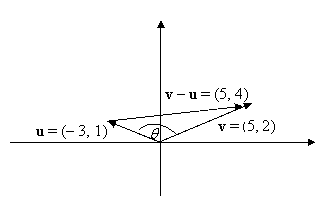
A dot product can be used to calculate the angle between two vectors. Suppose that v = (5, 2) and u = (–3, 1) as shown in the diagram shown below. We wish to calculate angle
between v and u.
To do this we use the formula
which can be derived using the Law of Cosines and the fact that
.
This gives us
allowing us to calculate the angle
.
Generalizing, we can calculate the angle between any two vectors u and v by using the dot product of the unit vectors in the same direction as v and u in this formula




- A constant force of 50 pounds is applied at an angle of 60º to pull a 12-foot sliding metal door shut. The diagram shown below illustrates this situation.
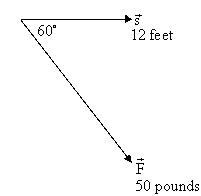
F is the applied force and s is the vector representing the direction the door slides.
We can represent these vectors as s = (12, 0) and F =
.
Simplifying F yields
.
We can now form the dot product and get our asnwer:
foot-pounds.
Notice that only the horizontal component of F affects the work. This result can also be found using the formula
.

- What is the angle between i = (1, 0) and j = (0, 1)?
We choose this example because we know that the angle between these basic unit vectors is 90º.
Verifying this information with our formulas yields:
and


What is the angle between v = (3, –7) and u = (–1, 9)?
A force of 20 Newtons is applied to an object at an angle of -45º with the horizontal. The object is pulled 10 meters at an angle of 25º with the horizontal. How much work is done while moving the object?
Advertisement