Word Lesson: Area and Perimeter of Circles
By M Ransom
In order to solve problems which require application of the area and perimeter (circumference) for circles, it is necessary to
- know how to use basic formulas for area and circumference of a circle. The area is pr2 where r is the radius of the circle. The circumference is found using the formula 2pr or pd, where r is the radius and d is the length of the diameter.
- solve basic linear and quadratic equations.
- use the Pythagorean Theorem in finding the legs or hypotenuse of a right triangle.
- know that the hypotenuse of a right triangle inscribed in a circle is a diameter of the circle, and know that the diagonal of a rectangle inscribed in a circle is a diameter of the circle. These facts are true because the diagonal of an inscribed rectangle is also a hypotenuse of a right triangle (half of the rectangle) and the legs of these triangles intercept half or 180º of the circle.
A typical problem involving the area and circumference of a circle gives us the area, circumference and/or lengths of the radius or diameter. We may also be given a relationship between the area and perimeter of other figures inscribed in the circle. We need to calculate some of these quantities given information about the others. Two examples of this type of problem follow:
- Suppose the circumference of a circle is 5p. What are the radius and area of this circle?
The circumference is represented by the formula C = 2pr and given as C = 5p
2pr = 5 p
r = 5/2Knowing that r = 5/2, we can find area using
A = pr2 = p(5/2)2 = 25p/4
We rely on the formulas for area and circumference. Sometimes we don’t know the radius or diameter when starting the problem. The radius and diameter are the key measurements in any circle.
- Suppose a circle has a circumference of 28p. A right triangle with an altitude of 4x and a base of 7x is inscribed in this circle as shown in the diagram below. What are the diameter of this circle and the area of the shaded region?
Always make sure that you have a diagram in situations like this where another figure is inscribed in a circle. In our diagram, observe that the base b of the triangle is also a diameter of the circle. We will use the fact that the diameter d = 7x to help solve the problem.
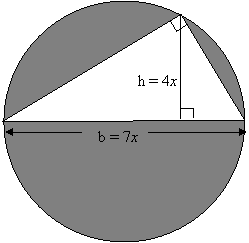
We were given that the circumference is 28p. We can use the circumference formula C = pd to solve for d.
pd = 28 p
d = 28Earlier we learned that the diameter of this circle could be represented as 7x since it is the hypotenuse of an inscribed right triangle.
7x = 28
x = 4The strategy to get the area of the shaded region is to subtract the area of the triangle from the area of the circle. The area of the triangle is
Atriangle = ½bh = ½(7x)(4x) = 14x2 = 14(4)2 = 224
Since the diameter of the circle is 28, its radius is r = 14. We can now find the area of the circle using A = pr2.
Acircle = pr2 = p(14)2 = 196p
Therefore the area of the shaded region
Acircle – Atriangle = 196p – 224 ≈ 391.75
 A circle has an area of 36p. What are the radius and circumference of this circle?
A rectangle with dimensions 5 x 8 is inscribed in a circle. What are the area and circumference of this circle? Also, find the area of the region inside the circle not covered by the rectangle.
A circle has an area of 45p. What are the diameter and circumference of this circle?
- circumference =
and the diameter is

- circumference =
and the diameter is

- circumference = 45p and the diameter is 45
A circle has a diameter of 30. A rectangle inscribed in the circle has dimensions x by 2x. What are the area of the circle and the area of the region inside the circle not covered by the rectangle? Express your answers in terms of p.
- Acircle = 225p and Auncovered region = 225p – 360
- Acircle = 225p and Auncovered region = 225p – 600
- Acircle = 225p and Auncovered region = 225p – 180 height = 9/2 or 4.5
A circle has an inscribed right triangle having an altitude of 4 and an area of 28 . What are the circumference and area of the circle?
- circumference = 14p and area = 196p
- circumference = 7p and area = (49/4)p
- circumference is 14p and the area is 49p
These types of problems involve relationships between the area and circumference of a circle as well as information about figures inscribed within the circle. The focus of these problems is to find the radius (or diameter since the radius is half of the diameter) of the circle. Once we know the radius, we can calculate either the area or the circumference of the circle.
Inscribed figures often give information about the diameter. The diagonal of an inscribed rectangle and the base of an inscribed triangle are both diameters of the circle. Sometimes information about these inscribed figures requires use of area formulas for the rectangle or triangle, or use of the Pythagorean Theorem, in order to find measurements of the diagonal of the rectangle or the base of the triangle.
When finding the area of a “shaded” region, i.e., the area of a portion of the circle NOT covered by an inscribed figure, it is simply a matter of subtracting the area of the figure inside the circle from the area of the entire circle.
Advertisement